
37. Felix Abraham III

Felix is Devastated
It is now 1936 and my Great uncle, Dr Felix Abraham, the younger brother of my grandmother Erna Marx, is precluded from working anymore because of the new race laws enacted the prior year. Nevertheless, Felix is determined to continue to serve his patients and sets himself up in various places as best he can under the circumstances with increasing difficulty. In this regard he starts to look further afield outside of Germany.
Felix’s Friends
Felix has many friends. He is over-generous with many of them, sometimes to his detriment financially.
Felix has a close relationship with Ellen Epstein, a Jewish concert pianist with the Berlin Philharmonic Orchestra. She performed in London in 1935. Ellen was eventually deported to Latvia with her sister in 1942 where they were both murdered.
One of his friends who spent some time at the Institute, is from Sweden. Erich Thorsfell spent a year in Berlin before returning to Sweden where he became a prominent trade unionist in the Swedish Metal Workers Union.
Felix Marries
Another young woman is Pini Engel, who is Jewish and whose family also lives in Berlin. Her father Alexander Engel is a book publisher. Such is their relationship that at some point Pini and Felix marry. Given his homosexuality it is not easy to understand the relationship but clearly whatever obstacle this was or what they were dealing with, marriage was important to them. It is unknown when they actually married.
Felix Goes to Sweden
Felix has connections in Sweden from his earlier work in Sexology, with some Swedish colleagues attempting to setup a magazine in Sweden. It is these connections that prompt Felix to see if he can establish himself amongst them, given that all opportunities are closed in Germany.
He leaves Pini in Berlin with her father, and applies to the Supreme Swedish Social Services in Stockholm for a residence permit. Without explanation in December 1936, his application is denied, probably because he is known to be Jewish and many in the medical profession at that time in Sweden are pro-Nazi. Felix has little choice but to return to Germany, back to his wife, Pini and at some point, he moves into his father-in-law, Alexander Engels’ house.
A Narrowing Future
In spite of his continuing drug-addiction and possible alcoholism and the absence of any aspect of civil life as a professional doctor and as a Jew, Felix continues to look for a brighter future. Berlin must have been extremely unpleasant for Jews and yet some sort of normal life did continue for them. At the same time he refuses to abandon his patients and attempts to remain registered as a doctor to support them as best he can.
With Sweden no longer a possibility, Felix considers starting anew in Italy. Meanwhile his continuing ill health from drug and alcohol abuse continues to be of great concern to all around him. My grandfather Erich persuades Felix to put himself into a clinic to undergo detoxification which he does, seemingly to no effect.
Financial Settlement
Felix is as usual having financial difficulties. He had been negotiating the reimbursement of a mortgage he had over the building of the Institute. He settles on extremely unfavourable and low terms, against the advice of his brother-in-law Erich, with the Nazi authorities but it does leave him with sufficient funds to consider other opportunities.
Berlin Police
At around this time in early 1937, the Berlin Criminal Police opens a file on Felix. The police start to investigate his drug abuse and stories that he distributed such drugs to others, which he is extremely likely to have done.
Italy
Felix considers starting afresh in Italy. The Criminal investigation may have played a part in this decision but the impossibility of working in Germany under any circumstances was probably the main driver. In April 1937 Felix, with the money he received from the authorities, moves to Italy. It is not known whether Pini accompanies him.
Italy is not the best of choices. Many of his friends wanted him to move to France (little did they realise that in a couple of years, that too would have been a bad choice). Felix settles on Italy because he does have connections there from his work at the Institute. It has been reported that he had had an earlier incident or relationship with a prosecutor in Brescia, a town in Northern Italy, and there is talk of some proceedings taking place in 1935. This would not have created a particularly welcoming environment.
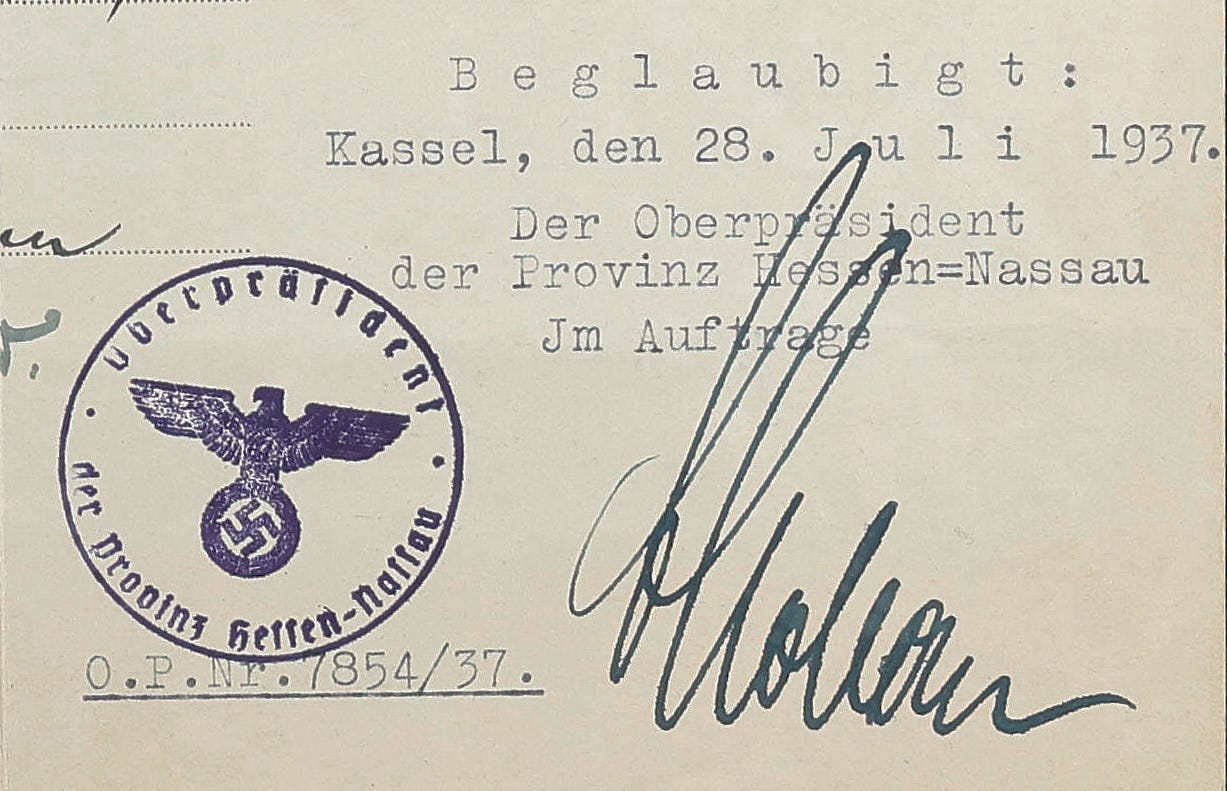
To establish himself properly, Felix needs to attend university again and take the Italian state examination. He requires certification of various documents which is why his school report has a Nazi stamp on it dated 28 July 1937 (see Post 34. Frankfurt Family). All of this is organised by his father-in-law.
Suicide
By this time, Felix is already having thoughts of suicide. He was acutely aware of the impact of the anti-Jewish measures imposed on the Jewish population throughout Germany, especially on his immediate family and friends, on his sister, on his nephew, my father and his niece, my aunt. The ultimate blow was discovering that the Berlin Police had become aware of his address in Italy.
On Wednesday the 8th of September 1937, nine days after his 36th birthday, Felix takes his own life with a pistol. He is buried almost immediately at the Jewish cemetery in Florence.
Although Jewish society strictly prohibits the burial of someone taking their own life, there is often sufficient rabbinic leeway established around such rules. It may have been thought or argued that Felix was mentally ill: the condition of mental illness would justify a decision to allow his burial. This would not have been a difficult argument to make, given the circumstances for Jews in Germany, the violent destruction of his place of work and the possibility of being deported for criminal proceedings. Perhaps Felix was already known to members of the community who recognised his delicate mental state.
Indeed, for many months it is thought by his family and friends, that Felix’s death was a result of a drug overdose but investigations by his father-in-law ascertained the facts.
Clearing Up
In the ensuing months, there is a lot of correspondence between Alexander and Erich. Various claims were made by people against Felix for money which Erich and Alexander had to deal with. Alexander sent to Erna the various documents he had prepared for Felix’s university enrolment which is why they are in the archive today.
Erna and Erich planned to visit Italy in 1937, but their changing circumstances and the ever-increasing Nazi restrictions meant this never happened. Nevertheless, Erna manages to organise a plaque to be placed on a cemetery wall. My sister, Caroline has a picture of the plaque with my dad, when they visited Florence in May 2006.
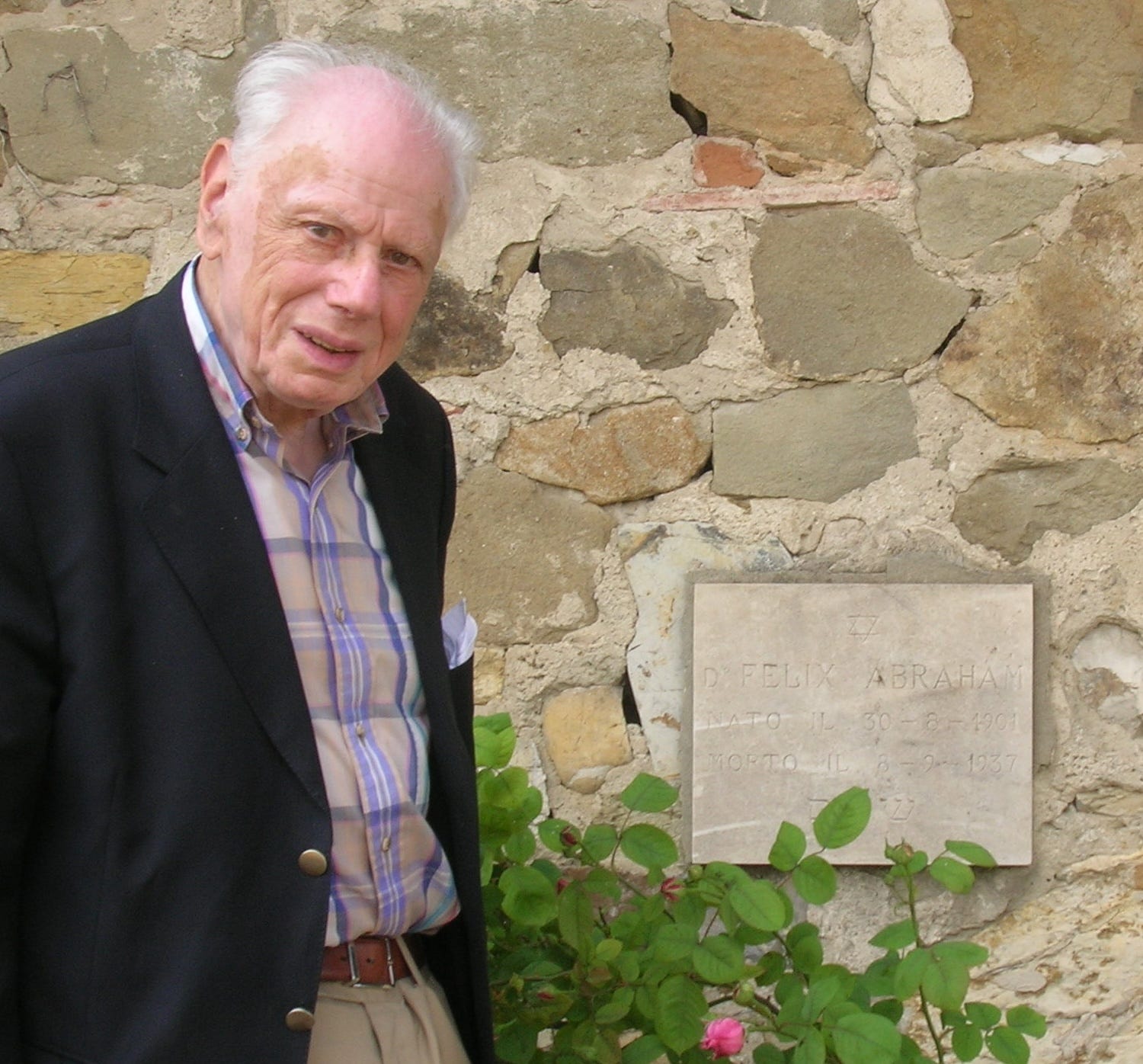
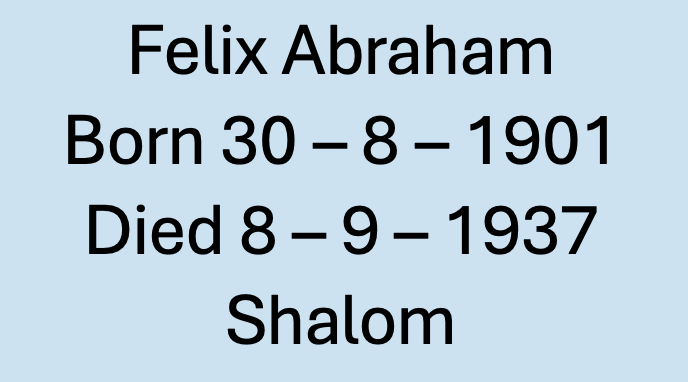
The plaque simply reads (translated from Italian and Hebrew):
Erna Marx
The content of the plaque is a stoic response and classic for my family to keep to the facts without emotion.
It is impossible to imagine the effect on Erna, his sister. Her loving concern for Felix was forever present for many years. Erna is also having to deal with her own family problems caused by the Nazis. It is unimaginable how she carries her grief while undergoing the traumas of rejection and vilification by her own country and its citizens. My father never records what it was like for his mother at that time, nor his relationship with Felix. I suspect it all becomes an inextricable part of the trauma for him of the times: note that this was all taking place in his teenage and early adult years.
Pini Marx
Pini goes into a severe decline with a mental breakdown following her husband’s death, not eating for days. This brings on a recurrence of an illness from a lung disease that she had previously overcome. It is not known whether she ever recovered or what happened to Pini.
I don’t think my father was aware of this marriage although he had all the correspondence between Pini’s father and his father, Erich. I wonder if this was deliberately left out of the various family trees or that he had not delved so much into the Marx papers as it was too painful for him, perhaps too close to home for him to address. Given his exhaustive and painstaking research in depth over the years in other areas, there is a notable absence of interest in what happened to Pini. I will never know and will return to this topic another time.
Pini’s Father Alexander Engel
Alexander Engel was already a widow by the time his daughter was married. He died in Munich in a Jewish hospital in July 1939.
As the chapter on Felix closes, we turn to his sister Erna, my grandmother and her family with Erich.
LIST OF NAMES: Please open Post number 18 to see all the family members that are mentioned here and in previous posts.
Attributions:
Many of the documents and photographs here are, or at some time in the future will be, lodged as a family archive with the Jewish Museum in Berlin. Jüdisches Museum Berlin, Schenkung von Frau Anne Marx in liebevoller Erinnerung an ihren Mann Carl Theodore.
Felix’s life story can in part be found here www.Stolpersteine-berlin.de
The Magnus Hirschfeld Society
https://magnus-hirschfeld.de
The Magnus Hirschfeld Society: Mitteilungen der Magnus-Hirschfeld-Gesellschaft Nr 54 June 2016 author Ralf Dose.
Photograph of plaque of my father next to the plaque for Felix, courtesy Caroline Lehman.